What does it means to feel safe and protected? Interview with Pie-Pacifique
10 July 2026
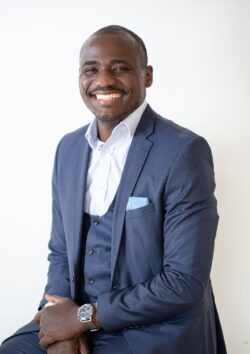 Born in Rwanda, Pie‑Pacifique Kabalira‑Uwase was still a young man when he witnessed the horrors of the 1994 Genocide. In 2001, he left his country on a treacherous journey that ultimately led him to seek refuge in South Africa, where he has lived in exile for 25 years.
Over the years, he has pursued his studies and earned a degree in Physics, going on to work as a business management consultant. Alongside his professional career, he has remained deeply committed to supporting others with similar experiences: he serves as a member of the JRS Administrative Council and advocates for the rights of refugees and other people forcibly displaced.
We asked what it means to him to feel protected. Here is what he shared with us:
Was there a moment when someone helped you or protected you?
There are many moments, but I will mention the most significant of all. In terms of protection, I believe if you are, in exile or a refugee or an asylum seeker, the freedom to have the opportunity to pursue your dreams is truly important.
And it always begins with documentation, because you need to be able to operate legally within the context in which you find yourself.
Shortly after I received my refugee status in South Africa, I wanted to study at University. I had been awarded a study loan; however, despite this, the university told me that the financial aid package I had been offered was a mistake, because there was no institutional policy in place to deal with cases involving refugee students. The situation began to change when I met the Dean of Student Services.
He was the first to say, “Actually, you have a point.” He then took it upon himself to bring the matter before the university council for discussion. It is a long story, it took time, but eventually the university adopted a new policy on refugees and established a fund to provide financial support in the form of student loans for refugee students.
Without his help, it would have been extremely difficult for me to access higher education. In this sense, he protected me. And after the policy was adopted, many refugees were admitted to the university, which was very positive.
What changed for you after that moment? How did it affect your journey?
At the beginning, when I arrived in South Africa, I was in transit. I thought I would stay there only briefly and then find a way to move on to the “West”, to Europe or America, wherever possible. But when I realised that tertiary education in South Africa was as good as anywhere else in the world, and studying had always been my goal, wherever I might end up, I decided to stop being in transit. I resolved to do everything I could to pursue a university education in South Africa, because afterwards I would be able to go anywhere I wished, but on my own terms. And that is exactly what happened.
I went on to complete a degree in physics. I then began my career in banking. Later, I moved from banking into management consulting, which is what I continue to do today.
I do not think that the course my life has taken would have been possible without the understanding of the Dean of Student Services, who, moreover, was the first senior figure I encountered who, after I had spoken to many others, said, “You have a point,” and chose to take the matter to the council. That was an act of protection. It was truly a defining moment in my life.
Have you ever been able to protect someone else?
When I was going through the process of gaining access to tertiary education, I was fighting a personal battle. But what I say today is this: if you fight a difficult battle based on principle, there is a chance that, when you win, you will not win alone. I am therefore very grateful for the role I played in helping the many refugees who were eventually able to benefit from that policy at the university.