The protection of refugees and other forcibly displaced people is often described through systems: legal frameworks, humanitarian standards, services, and programmes. But for refugees and other forcibly displaced people, protection is also experienced in a much more immediate and profound way. Protection is found when someone is present to listen, when people can turn to others who are on the same journey when they need help, when they are heard and participate in the decisions that affect them, and when support remains despite the end of a programme or attention moving to the next crisis.
Protection frameworks such as those developed by IASC and ICRC provide the humanitarian system with a common language for identifying violations, organising responses, and ensuring respect for people’s rights. Faith-Based Organisations also approach protection through a faith-sensitive lens, recognising that beliefs, spiritual identities, religious networks, and faith communities can shape how people understand risk, seek safety, exercise agency, and support one another.
For JRS, the protection delivered by institutions is complemented by what people build through relationships, collective agency, and sustained accompaniment. Formal protection systems remain essential, but trust, local networks and long-term presence can strengthen people’s own protective capacities and connect community experience with services and advocacy.
While the responsibilities of states, UN agencies, and the wider humanitarian system are essential and cannot be replaced, the depth and continuity of the relationships that Faith-Based Organisations (FBOs) have with local communities, refugees, internally displaced persons (IDPs), Refugee Led Organisations, and other actors can bring particular value to the protection of refugees and other forcibly displaced people.
On 29 September 2026, the role of FBOs and their local agency in protecting refugees and IDPs was discussed during a side event of the 2026 UNHCR-NGO Global Consultations, organised by the Jesuit Refugee Service (JRS) and Caritas Internationalis.
Speakers brought experiences from different contexts marked by forced displacement and reflected on the role FBOs can play as important, locally rooted, protection actors, particularly where displacement is prolonged, humanitarian access is difficult, and communities face multiple and overlapping challenges.
The sustained presence of FBOs
One of the strongest themes emerging from the discussion was the sustained and holistic presence of FBOs.
Humanitarian responses are frequently organised through programmes and funding cycles. Humanitarian events, however, do not unfold sequentially: even as a programme or funding cycle comes to an end, the same protection risk may re-emerge in different forms, unfold in new ways, or generate new vulnerabilities. Forced displacement can therefore outlast the temporal boundaries through which humanitarian responses are organised, with protection concerns continuing or changing long after an emergency disappears from international attention.
“Communities and our colleagues in the faith community are always the first responders to refugees, and they are often still there when funding cycles end,” noted Moses Mukasa, JRS Protection Lead. For Moses, the continuous presence that characterises FBOs has a direct protection dimension because “abandonment in itself is a protection risk.” This presence operates across different levels of reach within faith-based networks: from local faith communities and actors embedded in the everyday lives of displaced people, to organisations and networks able to connect local protection concerns with national, regional, and international advocacy.
“We play a role of reaching out to the displaced communities in areas that others are not even able to reach,” explained Felix Omollo, who works for JRS in South Sudan. Felix observed that in South Sudan, churches, mosques, and other places of worship are often among the first places where people seek support during crises. This observation was echoed by Paul B.B. Kithima, speaking from his experience of refugee-led leadership and localisation in Uganda, where he explained that “faith based organizations, being very close to the community through the churches and their networks both in cities and settlements, are often the first place many refugees go to.”
Víctor Castro Quijada from Caritas El Salvador shared how displacement in El Salvador is complex: people may be internally displaced, returning after being deported, or moving through the country as part of longer migration journeys. These mixed migration flows are taking place within a local and international political context that makes it increasingly difficult to address people’s protection needs. Despite these challenges and the reduction in resources, Castro stressed how faith communities are responding with courage and creativity. They are building networks of care and solidarity and training parish volunteers and educators to support people in need. Importantly, this presence continues even when displacement is no longer receiving public attention.
This continuity matters. A locally rooted organisation may have known a community before a crisis began, remain present during the emergency, and continue accompanying people after international attention has shifted elsewhere. Protection, in this sense, is not only an intervention, but also a relationship maintained over time.
Accompaniment as a protection approach
Sustained presence is closely connected to the faith-based approach of accompaniment, which is at the centre of FBOs’ protection work.
Moses described accompaniment as “working alongside people, not doing for people,” highlighting how accompaniment is not rhetoric, but rather means being consistently and intentionally present alongside displaced people, enabling their participation, elevating their voices and co-creating solutions rather than replacing their perspectives with those of humanitarian organisations. Moses also added that accompaniment means upholding the dignity and self-determination of people affected by humanitarian crises, natural disasters and other events.
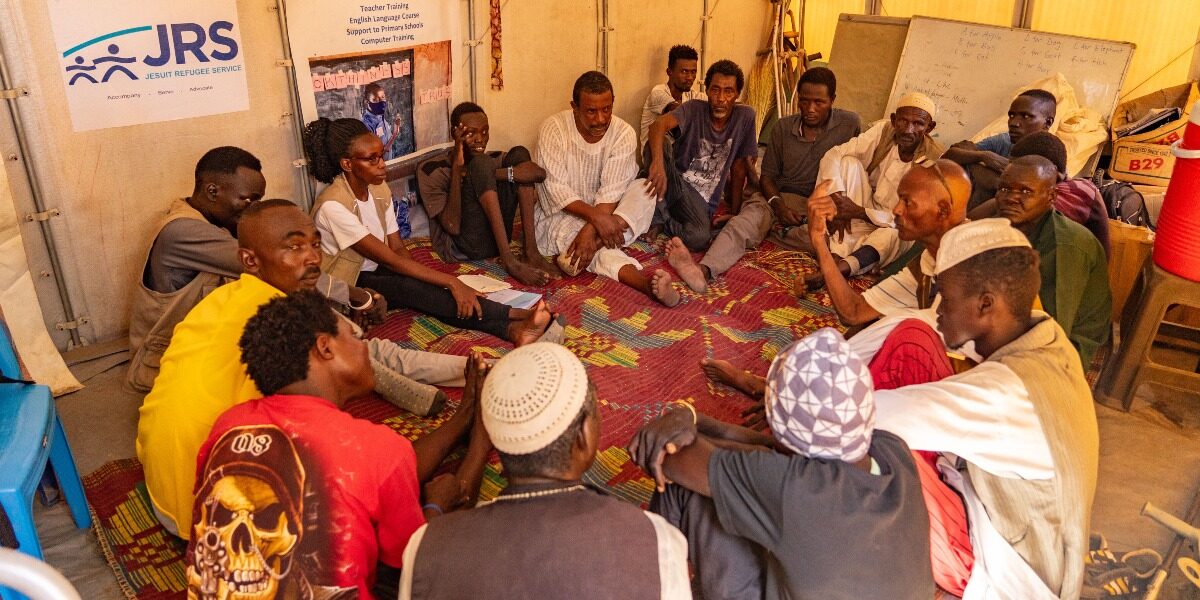
Felix explained how in Renk, South Sudan, where more than one million people have arrived after escaping violence in Sudan, Faith-Based Organisations provide spaces where people can speak about their concerns and identify solutions. They provide psychosocial first aid and discuss with people the protection issues they may encounter. FBOs are also involved in bringing people together, fostering dialogue and creating community, as well as offering spiritual and emotional support so that people can regain a sense of hope. “I would not say that our role as faith-based organizations is completely different from others,” Felix notes, mentioning that FBOs provide services such as education or psychosocial support, as other actors do. “What is different is the way we engage the communities, we build long term presence. We build trust and we accompany and journey with them,” he said.
Víctor shared how their faith sustains their presence in the community of El Salvador, accompanying people even when the crisis no longer makes the headlines. Through this presence, they can see how the causes that forced people to leave their homes are still present and are being compounded by mistrust fuelled by political narratives that portray them as criminals. “Their stories call out on us to be the very Church that accompanies those who leave, those who are passing through, and those who return, no matter which country they are travelling from,” Victor said.
Fostering agency and partnership
FBOs can also play an important role in helping ensure that refugees and displaced people are not simply recipients of protection but are also able to participate in shaping the systems, programmes, and interventions that affect them.
For Moses, “when we say we are accompanying – which means we are working alongside people – we can document what happens to them, what we witness every day. We can push back to member states and UN agencies and bring these conversations to spaces where those who are affected will not have an opportunity to even sit or voice their needs.”
This argument connects closely with the reflections of Paul B.B. Kithima, who noted that while refugee-led organisations (RLOs) and FBOs have much in common, including being close to and trusted by the people they serve, FBOs are often connected to churches, congregations, and institutional networks built over decades or even centuries. Those networks can provide advocacy reach and institutional connections that newer RLOs may not yet possess.
This creates an important opportunity, according to Paul: rather than FBOs simply creating more programmes for refugees, faith-based and refugee-led organisations can work alongside one another so that self-sufficiency becomes part of refugees’ everyday lives.
Making protection local, relational, and sustained
In conclusion, FBOs do not replace the responsibilities of states, UN agencies, or other actors in the international protection system. Their distinctive value lies elsewhere: FBOs can help ensure that protection remains connected to the communities it is intended to serve. They can help make protection local, relational, and sustained.
Explore more